
Complaints management for suppliers
Complaints mechanism:
We take responsibility for the people involved in the production of our textiles. To this end, we work exclusively with suppliers that demonstrably fulfil our high standards regarding human rights, environmental protection, and health.
In addition to recognised seals, we value the personal exchange with our suppliers. Because only those who know where the problems lie can act effectively.
Therefore, one of our core concerns is offering employees the opportunity to contact us directly if they have any complaints:
Contact: Mrs Michaela Gnass, CSR Manager, e-mail: gnass@dibellatextiles.com, phone: +49 (0) 2871 2198-63
Processes and procedures
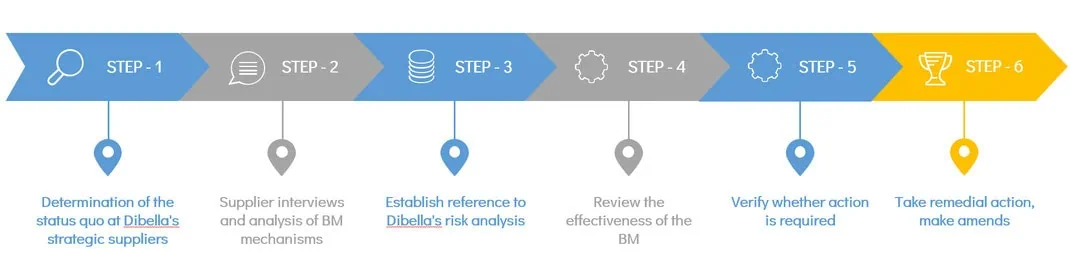
Procedure:
A) Dibella identifies complaint mechanisms / communication channels with strategic suppliers
Data collection structured according to:
- Country
- Certifications (GOTS,…)
- Complaints received
- Finding solutions
- Associations/trade unions
- Complaint boxes
- Integrated complaints policy/documentation
Result: Integrated complaint mechanisms/communication channels from all strategic suppliers are available through enquiry. All strategic suppliers have their own complaints channels.
B) Dibella analyses complaint mechanisms/communication channels with strategic suppliers
Analysis
1. Establish link to Dibella’s risk analysis
Result: Country-specific and already prioritised risks are set in relation to the respective complaints mechanism of the strategic supplier
C) Dibella reviews complaint mechanisms/communication channels for effectiveness
Checking effectiveness through
- Audits, certificates
- through Dibella’s own projects*
- Review of implemented measures through “on-site visit”/checklist
* Germany = Implementation of an “Inflation compensation for employees of a supplier” project in spring 2024. A detailed report will follow.
Result: Complaints mechanisms/communication channels are tested and assessed for effectiveness
D) Dibella derives further measures if necessary
Check whether further measures are required
- Initiate CAP
- see C) Check the effectiveness again
E) Dibella remedies the Remedy/redress
Remedy the situation and provide access to redress
- Dibella fulfils the organisational and personnel requirements.
These have been set up and corresponding responsibilities defined with the following contacts:
Purchasing Manager: Mr Simon Bartholomes
CSR Manager: Mrs Michaela Gnass - Question: Has remedial action/redress been taken in the last 12 months?
Complaint received 2022/2023 During a visit to a Pakistani supplier’s sewing facility in 2022, employees complained about uncomfortable chairs in the sewing room. In dialogue with the 80 people affected, it was agreed to provide a selection of alternative chairs. After a test phase, the employees decided in favour of a model with an upholstered backrest. Those affected are satisfied with the remedial action taken and have given us positive feedback.
Two complaints received in 2024 In spring 2024, we received a complaint by e-mail from two former employees of a supplier. The employees told us that they had been made redundant because capacities had been reduced. At the same time, new staff were recruited. Dibella arranged a mediation meeting with the supplier. One employee attended the appointment, one did not. One employee has accepted a new position at another company and thanked us for our support. One employee did not provide any further feedback despite us contacting him several times.
Complaint recceived in 2025 An employee of a supplier informed us that a scheduled wage increase had not yet been paid. Following our inquiry, the supplier explained that wage increases are linked to a formal qualification-based grading process and are therefore implemented only after the completion of the relevant internal review and approval procedure, which may result in payment in later payroll period. The delay was therefore attributable to the supplier’s administrative process.
Dibella operates according to the “precautionary” principle. Dibella initiates and finances projects via the GoodTextiles Foundation to promote positive social and ecological effects.
Example: Training centre for organic Fairtrade farmers, school projects to promote education, offsetting CO2 emissions in the Dibella forest, etc. (further information at: www.goodtextiles.org)
In the event of a remedy/reparation, the following process takes place:
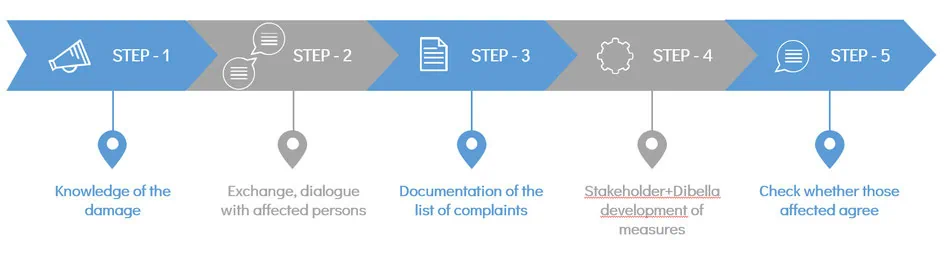
Re 1) Knowledge of the proven damage
Re 2) Exchange/dialogue with affected parties (travel or in writing)
Re 3) Creation of documentation (list of complaints)
Re 4) The stakeholders and Dibella develop joint remedial measures (form and amount)
Re 5) Check whether those affected agree with the result. If necessary, initiate CAP.
